Renewable Energy Transformers: A Key Link in System Performance
31/03/2026
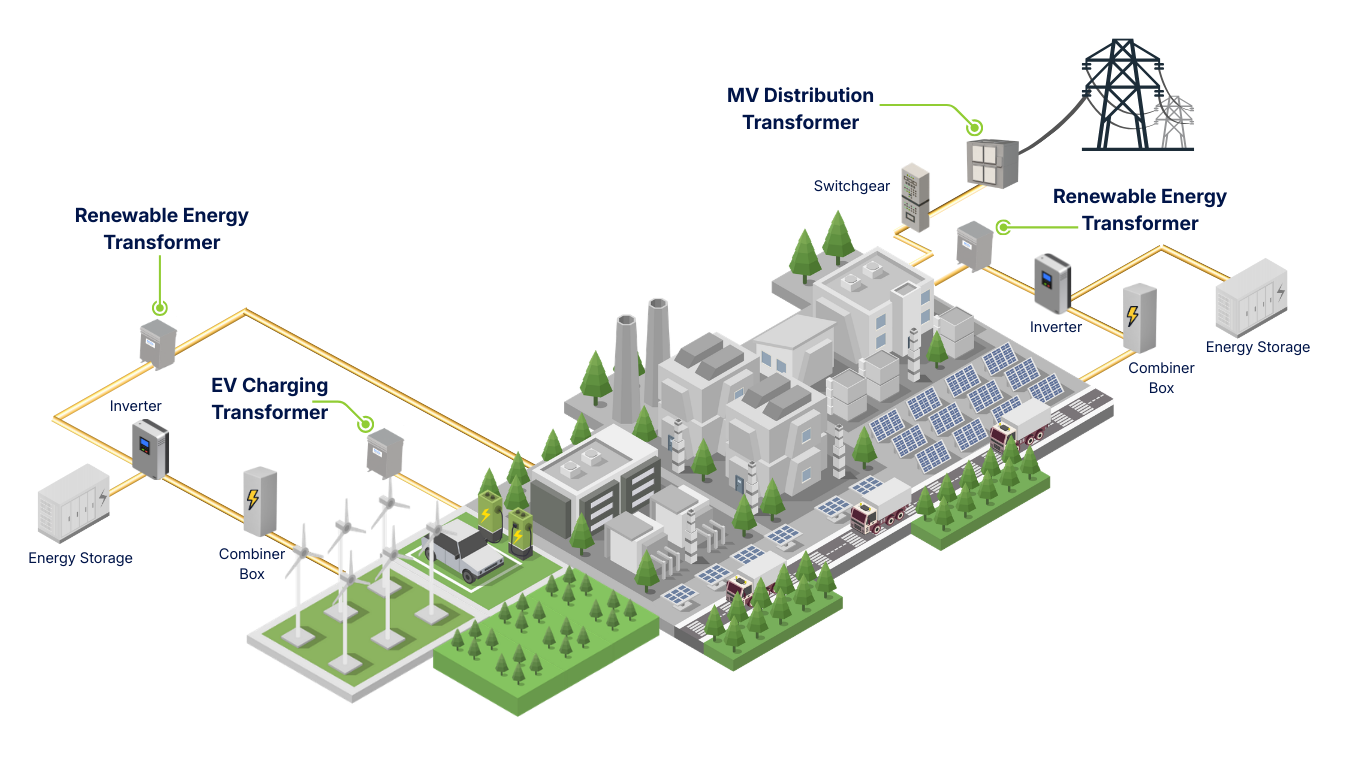
As power demand continues to grow and grids face increasing pressure, solar, wind, and battery storage systems have become essential pillars of the energy transition. Within this complex architecture, the transformer remains a key component for ensuring system reliability.
Far more than a simple device within the energy chain, it directly influences overall efficiency, system availability, and installation lifespan. In renewable applications, where load profiles and operating conditions shift rapidly, the choice of transformer becomes a determining factor in long term performance.
This article summarizes the key insights on the role of modern transformers in renewable energy systems, highlighting essential design principles, engineering considerations, and selection recommendations.
Why are standard transformers not enough?
Unlike transformers used in conventional installations, those integrated into solar, wind, or storage projects face significant load variation. Production may peak around midday and drop sharply at other times, creating repeated thermal cycles. These units are also frequently installed outdoors, where they must withstand weather exposure, humidity, and inverter generated harmonics. In this context, proper transformer design is essential to ensure durability and reliability.
How do renewable energy requirements influence transformer design?
Modern installations often involve bi directional power flow: energy may be injected into the grid or redirected to recharge storage systems. This reality changes traditional design approaches. Identifying the “grid side” and the “inverter side” helps optimize tap placement and manage inrush current, ensuring stable voltage and optimal equipment performance.
How do we manage thermal constraints and harmonics?
Heat remains one of the main factors contributing to transformer aging. In renewable energy installations, rapid production fluctuations and the non linear loads of inverters amplify these stresses. Appropriate design, including optimized thermal management and the use of K rated transformers when required, helps reduce losses and extend equipment lifespan.
Delta Transformers: A Technical Design Tailored to Renewable Energy Systems
Delta transformers are engineered specifically for renewable energy applications, delivering a high level of reliability and performance.
Designed for demanding environments: Withstand humidity, extreme temperatures and dust.
Optimal load handling: Adapt to rapid production variations, repeated thermal cycles and inverter harmonics.
4-or-5-legged cores: Provide an alternate flux path for better phase loss detection and enhanced safety.
Epoxy Vacuum Impregnation (EVI): To ensure protection and flexibility to accommodate expansion and contraction during load cycles.
Performance and cost efficiency: Stabilize voltage, reduce energy losses and extends equipment lifespan.
Conclusion
In renewable energy systems, the transformer is a cornerstone of stability, protection, and performance. Choosing the right design makes it possible to transform the inherent variability of renewable sources into reliable, long lasting and efficient operation.
Watch the webinar to explore these points in detail:
Cookies help us improve your website experience.
By using our website, you agree to our use of cookies.